


Canning lentils 4 ways: Mediterranean & Indian-Inspired, East asian and Spanish lentils
Part 1 of my Canning Lentils 4 Ways series. The post became too long with trying to cram everyting in there. So making 4 post throughout september.

I love canning lentils.
They're cheap, nutritious, filling and one of those pantry staples that can turn into dinner remarkably quickly.
But here's the problem.
Once you've canned a shelf full of plain lentils, you eventually find yourself staring at twenty nearly identical jars thinking:
Okay... what am I actually going to do with all these lentils?
For basic recipie to can lentils, check out my post: Canning Lentils: A practical guide for home preservation
So this year I'm doing things differently.
I'm canning lentils four ways, creating four completely different flavour profiles that can become quick lunches and dinners straight from the pantry.
I'm making:
Mediterranean lentils. Indian-inspired lentils. Spanish-style lentils. East Asian-inspired lentils.
And rather than putting four enormous recipes into one enormous blog post, I'm dividing them into two parts.
In Part 1, we're making Spanisg style lentils and for the upcoming months, Indian-inspired lentils, an east Asian-inspired version and finlly a mediterranean version.
Same humble lentil. Four very different jars.
First, an important note about canning safety
Before we start chopping onions, let's talk about the slightly less exciting but considerably more important part.
These exact flavour combinations have not been laboratory tested as individual recipes.
Low-acid foods such as lentils and vegetables must be pressure canned. You cannot safely process these recipes in a boiling-water bath.
For mixed soups containing dried beans or peas, established home-canning guidance requires ingredients to be prepared appropriately before combining them, jars to be filled with a substantial proportion of liquid rather than packed densely with solids, and the finished product to be pressure canned.
I also don't add flour, cornstarch or other thickeners before canning, nor dairy, coconut milk or large amounts of fat.
If you preserve only recipes that have been laboratory tested in their exact formulation, stick with published recipes from organisations such as the National Center for Home Food Preservation or USDA.
For everyone else, understand what you're changing when you adapt a recipe and never assume that pressure canning automatically makes any homemade recipe safe.
Now let's make some lentils!
Recipe 1: Spanish-Style Lentils
Living in Spain for years has completely changed how I think about lentils.
Growing up in Sweden, lentils weren't exactly something I associated with comfort food.
Here?
Absolutely.
A bowl of lentejas on a cold winter day is proper comfort food.
Spanish lentil stews can contain everything from potatoes and carrots to chorizo, pork and other meats depending on who is making them.
For my canned version, I'm keeping things simpler.
The flavour I'm after comes primarily from tomato, garlic, onion and smoked paprika.
Then when I open the jar, I can decide whether I want to eat it as it is or turn it into something more substantial.
Ingredients
Makes approximately 4 pint/500 ml jars.
You'll need:
250 g dried brown or green lentils
1 medium onion, diced
2 carrots, peeled and diced
1 red bell pepper, diced
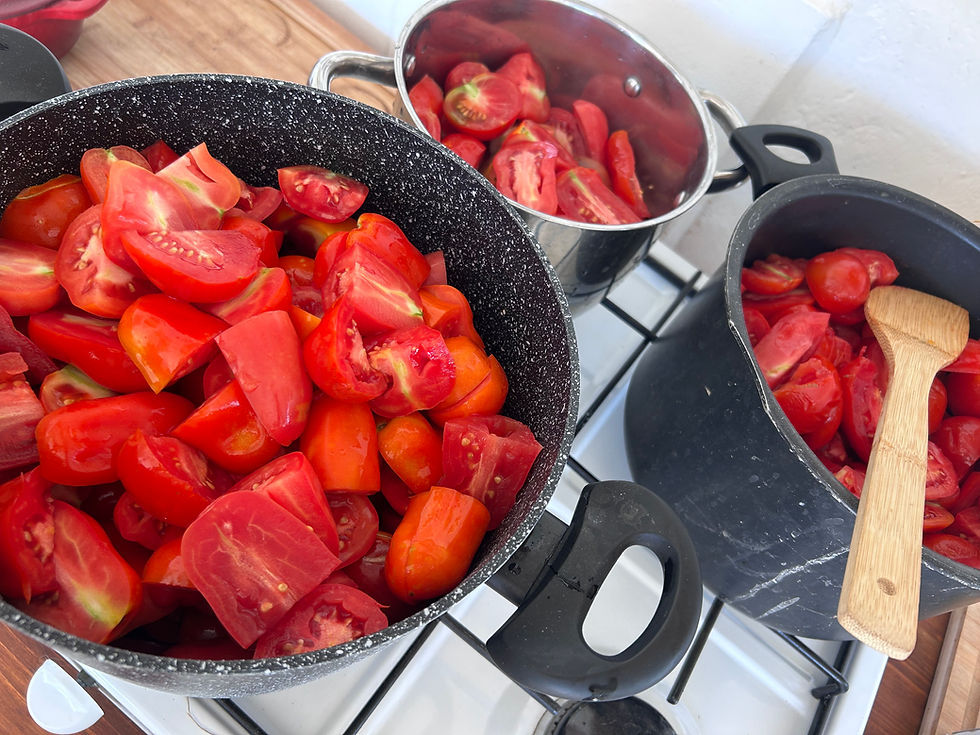
250 g chopped tomatoes
2 cloves garlic, finely chopped
1 teaspoon sweet Spanish paprika (pimentón dulce)
½ teaspoon smoked Spanish paprika (pimentón de la Vera)
1 small bay leaf
Water
Salt, optional
If you like a little heat, you could swap some of the sweet paprika for pimentón picante.
Personally, I'd rather keep the jars relatively mild and add heat when serving.
Step 1: Quick-Soak the lentils
Sort through the dried lentils and remove any little stones or damaged lentils.
Rinse them well.
Put the sorted lentils in a large pot, cover with water. Bring to a boil and boil for 2 min. Turn off the heat and let them soak in the hot water for 1 hour.
Step 2: Pre-cook the lentils
Discard the soaking water and cover the lentils with clean water.
Bring to a boil and boil for 30 minutes.
Remember, we're not trying to cook them until completely soft.
They still have plenty of cooking ahead of them in the pressure canner.

Step 3: Make the Spanish vegetable base
While the lentils are cooking, dice your onion, carrots and bell pepper.
Add them to a large saucepan with the chopped tomatoes, garlic and the bay leaf.
Add enough water to keep everything loose and soupy.
Bring to a boil and simmer for around 5 minutes.
Now add the sweet and smoked paprika.
The smell at this point is already VERY Spanish.
Add the pre-cooked, drained lentils and stir everything together.
Add more hot water if necessary.
Remember we want soupy, not a thick lentil stew.
Remove the bay leaf before filling your jars.
Step 4: Fill the jars
Have your clean, hot pint/500 ml jars ready.
Using a slotted spoon, add the lentils and vegetables, filling each jar about halfway with solids.
Then ladle the hot liquid over them.
Leave 1 inch / 2.5 cm headspace.
Run a bubble remover or non-metallic utensil around the inside of each jar.
Check your headspace again and add more hot liquid if necessary.
Wipe the rims and apply the lids and bands fingertip-tight.

Step 5: Pressure can
Place the jars into your pressure canner and process them.
For pint/500 ml jars using the mixed-soup method:
Process for 60 minutes, using the appropriate pressure for your type of pressure canner and altitude. As always, vent for 10 min before adding your weight.
Once processing is complete, turn off the heat and let the canner depressurise naturally.
Don't force-cool it.
Once fully depressurised, follow your canner manufacturer's instructions for opening it safely.
Remove the jars and leave them undisturbed for 12–24 hours before checking the seals.
And that's batch number 1 done!
Turning the Spanish jar into dinner
This is where things get interesting.
You could simply heat the jar and eat it with crusty bread.
Honestly, I'd be perfectly happy with that.
But you can also use it as the base for something much more substantial.
Heat the contents gently in a saucepan and adjust the seasoning.
You could add a little more smoked paprika, some freshly ground black pepper and a drizzle of good olive oil.
And if you want something closer to a traditional hearty Spanish lentejas, you can add cooked potato and sliced chorizo while reheating.
Let everything simmer together for a few minutes.
Suddenly your humble jar of lentils has become a proper winter dinner.
That is precisely why I'm making these.
Why not just can plain lentils?
You absolutely can.
And plain lentils are incredibly useful.
But I've realised that there are two different things I want from my pantry.
Sometimes I want ingredients. Other times I want meals.
When I get home late, I'm much more likely to reach for a jar labelled:
Indian Lentils than stare at a jar labelled: Lentils
and start wondering what I should make for dinner.
It's the same reason I love having canned soups and sauces on the shelf.
I'm not only preserving food. I'm preserving time.
I hope you enjoy this version, and follow along as I try more of these!


Comments